
Cross-Border Breach of Contract: A Pre-Action Decision Framework and Prompt Solution for Assessing Whether Pursuit Is Viable

Part 1 - Introduction
The objective of this piece is to map the decision architecture for navigating a potential breach of contract in a cross-border context.
The framework that follows identifies the key decisions that determine how a situation like this could be assessed and in what order those decisions could be made. It is not exhaustive. It is designed to make clear what matters, in the right order, before any decisive action is taken — establishing a working map of the issue, the decisions it produces, and where those decisions lead.
The final component is a prompt solution — built around a defined problem and a solution that is customizable to specific facts, circumstances, and jurisdictional considerations — that applies this framework dynamically to produce a structured assessment of the situation.
Illustrative Scenario: Why Most SMEs Absorb the Loss — When Overseas Supplier Doesn’t Deliver
A Canadian company orders $80,000 of components from a UK manufacturer. Delivery is late, the specifications are wrong, and the supplier has gone unresponsive. The company’s lawyer delivers an honest assessment: cross-border enforcement will cost in the range of $40,000 and take the better part of two years. The company writes it off. The figures used in this scenario — the damages value and the enforcement cost estimate — are constructed for illustrative purposes only. Actual enforcement costs vary significantly by jurisdiction, claim complexity, and legal representation and should not be treated as planning benchmarks.
This scenario in its various permutations likely happens to a significant number of businesses engaged in cross-border transactions each year. In many cases the claim has merit. What is often missing is a structured framework for assessing whether pursuit is viable before the decision to absorb the loss is made.
The write-off is not necessarily irrational. It may be the most reasonable response available when the information needed to make a better determination does not exist in accessible form. This piece looks to provide a structured framework as a starting point for making that determination.
Domestic versus Cross-Border Breach of Contract: The Structural Difference
Understanding the structural difference between a domestic and a cross-border breach of contract is the necessary starting point as it determines how the relationship between the parties is governed, what rights each party holds, and what mechanisms are available to enforce them. The moment the parties are located in different jurisdictions, each of those questions becomes materially more complex.
A domestic contract dispute and a cross-border contract dispute may look identical on the surface — one party failed to perform, the other suffered a loss. The legal principles governing breach are largely the same. What is not the same is the decision architecture for responding to it.
In a cross-border dispute, each of those variables becomes a decision problem in its own right. Before the question of whether to pursue the claim can be answered, a prior set of questions must be resolved — questions that many SMEs may not know to ask. The result is that the decision to absorb the loss gets made not on the merits of the claim but on the absence of a structured way to assess it.
This structural difference is what makes cross-border breach of contract one of the more consequential and least structured challenges an SME is likely to face in its commercial relationships — consequential because the variables are multiple and interconnected, and least structured because the decision architecture for navigating them is rarely available in accessible form. The commercial calculus will differ for every operator depending on the nature of the relationship, the role the counterparty plays within the business, and a range of factors that are specific to the situation — which is precisely why a structured assessment framework is more useful than a general rule.
The Key Variables That Underpin the Commercial Viability Assessment
Cross-border contract breach can be assessed through four sequential variables. Each one informs the next. Navigating any one of them without adequate information — in either direction — risks a poor outcome: an abandoned claim that was worth pursuing, or a pursued claim that was never going to be recoverable. The variables identified here are not exhaustive — they represent the key structural considerations that commonly determine whether pursuit is viable.
These variables are broadly consistent with the principles that underpin international commercial dispute resolution as recognized across established international commercial practice — including the frameworks applied in institutional arbitration and commercial litigation. While those frameworks are designed for disputes of a different scale and complexity, the underlying principles are relevant across commercial relationships of all sizes, including those involving SMEs operating at the scale illustrated in the scenario above.
Variable #1 - Governing Law
The law that governs the contract shapes everything that follows. Specifically, this variable is a significant determiner as to what constitutes a valid breach, what remedies are available, how damages are calculated, and in what forum a claim can properly be brought. It is not uncommon for a significant proportion of commercial contracts — notably those formed through purchase orders, email chains, or supplier terms that were never properly reviewed — to either lack a governing law clause entirely or contain one that is ambiguous, inconsistent with other terms, or not understood by the party who signed it.
Where governing law is clearly established by the contract, the analysis has a defined starting point. Where it is absent or ambiguous, a prior determination is required — and that determination is itself consequential, because different governing laws produce materially different outcomes on the same set of facts. A breach that gives rise to significant damages under one legal system may give rise to limited remedies under another. The treatment of liquidated damages clauses illustrates this point — what is enforceable as a pre-agreed damages mechanism under one governing law may be characterized as an unenforceable penalty under another, materially affecting what the non-breaching party can recover without further proof of loss.
The governing law question is where many cross-border disputes are effectively decided before anyone realizes a decision has been made.
Variable #2 - Jurisdiction
Knowing which law governs the contract is separate from knowing where a claim can be brought. Jurisdiction — the authority of a particular court or tribunal to hear a dispute — is determined by a combination of contract terms, the location of the parties, where the contract was performed, and in some cases where the loss was suffered. Like the governing law variable, jurisdiction is often addressed by a clause in the contract. In some cases the clause is absent, poorly understood, or conflicts with other terms — a not uncommon outcome where both parties have issued their own standard terms, each specifying a different governing forum, without either having identified or resolved the conflict — noting that the resolution of such conflicts is itself governed by the applicable governing law, which reinforces why the governing law determination in Variable 1 is the foundational starting point for the entire assessment.
The practical significance of jurisdiction goes beyond the question of where a claim can be filed. It determines the procedural system the claimant must navigate, the language in which proceedings occur, the timeline, and the cost structure of the proceedings. A jurisdiction that is technically available may be practically inaccessible for a dispute of a given size — where the cost of commencing and maintaining proceedings in a foreign forum consumes a disproportionate share of the recoverable damages, the technical availability of that jurisdiction provides little practical utility. These operational considerations cannot be assessed in isolation — establishing the jurisdictional foundation is a necessary precondition to any meaningful assessment of whether pursuit is viable.
Variable #3 - Enforceability
Obtaining a judgement and collecting on it are two entirely different problems. A judgement issued by a Canadian court against a UK supplier is not automatically enforceable in the UK. Enforcement depends on the existence of reciprocal enforcement arrangements, the specific jurisdiction within which enforcement is sought, and the practical circumstances of the defendant — whether they have assets accessible to enforcement, whether they are likely to comply voluntarily, and whether the enforcement process in the relevant jurisdiction is itself cost-effective relative to the judgement value.
The Canada-UK relationship illustrates this point, though with an important qualification. A judgment obtained in either jurisdiction against a defendant based in the other is not automatically enforceable — a separate application to the courts of the enforcing jurisdiction is required for recognition and enforcement. However the process is more streamlined than the general foreign judgment rules might suggest. Canada and the UK are parties to a bilateral treaty — the Convention Providing for the Reciprocal Recognition and Enforcement of Judgments in Civil and Commercial Matters — implemented in the UK through the Foreign Judgments (Reciprocal Enforcement) Act 1933. Under this framework a judgment creditor in either jurisdiction can apply to register a judgment in the other through a simplified procedure rather than commencing fresh proceedings. Once registered the judgment carries the same legal force as a domestic judgment in the enforcing jurisdiction. The procedural layer and associated cost are therefore real but materially less burdensome than enforcement against a defendant in a jurisdiction without a comparable reciprocal framework — a distinction that underscores why the specific jurisdictions involved are a material variable in any cross-border enforcement assessment.
Enforceability is one of the more significant considerations worth examining before committing to pursuit. The assumption that winning the case is the hardest part is reasonable on its face — but in cross-border disputes it is frequently not the case. Winning the case and recovering the loss are frequently separated by a second, equally demanding process. A claim that is legally sound and jurisdictionally viable may still be practically unrecoverable — and any meaningful assessment of whether pursuit is viable must account for that reality.
Variable #4 - Commercial Viability
The first three variables establish what is possible — this fourth considers whether pursuit is sensible. The commercial viability assessment is the structured integration of the preceding determinations — governing law, jurisdiction, and enforceability — with the practical variables that shape the real-world calculation. These practical variables include but are not limited to the quantum of the loss, the estimated cost of recovery, the time required, the likelihood of success on the merits, and the opportunity cost of the resources the pursuit will consume.
This is not a simple arithmetic exercise. These variables interact in ways that are not always linear. A claim with a lower probability of success may still be worth pursuing if the enforcement cost is minimal and the relationship with the supplier is already irreparably damaged. A claim with a high probability of success may not be commercially viable to pursue if the enforcement jurisdiction makes recovery prohibitively expensive relative to the quantum. The assessment requires a structured framework, not an intuitive calculation.
Beyond the Framework: Contextual Considerations
The four key variables identified above are a starting point for assessing whether a claim within a potential dispute is worth pursuing. As noted earlier, they are not exhaustive of all the variables that shape a complete response — there will of course be scenario-specific factors. There are however additional considerations that sit alongside the assessment and that will at times take precedence.
Contractual gaps are more common than they might appear. Commercial contracts — notably those formed in the context of international supply relationships — may not be drafted with dispute resolution in mind. Governing law clauses may be absent. Jurisdiction clauses may be missing or inconsistent. Limitation of liability provisions may cap recoverable damages at levels that make pursuit unviable regardless of the merits. Understanding what the contract actually says, and what it does not say, is a prerequisite to any meaningful assessment.
The insurance variable. Trade credit insurance and cargo insurance both potentially respond to cross-border supply failures, depending on the nature of the loss and the policy terms. It is worth confirming whether existing insurance coverage responds to the loss before a decision to pursue a claim is made — an insured loss changes the commercial calculus significantly.
The relationship variable is real. In some cross-border supply relationships, a supplier who failed to perform on one contract remains a viable and valuable partner for future business. Formal pursuit — particularly across jurisdictions — is rarely conducive to relationship preservation. This is not a reason to abandon a legitimate claim, but it is a variable that belongs in the commercial viability assessment alongside the other considerations.
Reputational and market considerations. Cross-border disputes in specialized supply markets are not always private. The decision to pursue, and how to pursue, can have effects beyond the immediate dispute that are worth accounting for in the assessment.
Time is a cost that does not appear on the invoice. The management time consumed by active proceedings — across jurisdictions, potentially in a foreign legal system — is consistently underestimated at the outset. For an SME without dedicated legal resources, that cost can be material relative to the quantum of the claim.
Documentation and preservation. The quality and completeness of the documentary record is a material variable in any cross-border dispute. Correspondence, purchase orders, delivery records, specifications, and any post-delivery communications should be gathered and preserved before any pursuit decision is made. The strength of the documentary record affects every variable in the assessment framework — from establishing the breach to calculating damages to supporting the governing law determination where the contract is informal.
Limitation periods. The applicable limitation period — the window within which a claim must be commenced — should be identified before any other assessment is undertaken. An expired limitation period renders the framework moot regardless of how clearly the other variables resolve. Limitation periods vary by jurisdiction and by the nature of the claim — and in some jurisdictions by when the loss became known rather than when the breach occurred. Where there is any uncertainty about which limitation period applies, that question warrants priority attention before any other aspect of the assessment is undertaken. Where there is any uncertainty about whether the limitation period is live, that question warrants priority attention.
The Operational Value of Structured Assessment in a Cross-Border Context
At the threshold of cross-border contract disputes, the decision to write off a loss—particularly when a supplier fails to deliver—is rarely driven by a lack of legal merit. Instead, it is typically a consequence of acute informational friction. At the moment the decision is required, the data required to evaluate a cross-border claim is rarely structured or accessible. Consequently, the primary financial hurdle is not the ultimate cost of pursuit, but rather the immediate cost of reducing uncertainty—the price paid just to discover if winning is even possible.
The structured assessment framework addresses this dynamic by isolating the core variables dictating a claim’s viability. Rather than demanding exhaustive, open-ended legal discovery, the framework applies targeted analysis to answer foundational threshold questions. This produces a structured commercial viability assessment, integrating the four framework variables with the contextual considerations identified above.
The objective of this framework is not to guarantee a successful recovery but to reduce the informational friction that makes a meaningful pursuit assessment prohibitively expensive at the outset. By incorporating scenario-specific variables into the assessment, the framework provides a structured basis for determining whether pursuit is commercially viable — replacing an uninformed write-off decision with one made on the basis of the information that should have been available from the start.
Jurisdictional Scope
The assessment framework presented in this piece is designed for commercial contracts governed by common law principles. Contracts governed by other legal traditions operate under materially distinct doctrines, particularly regarding contractual interpretation and available remedies, and the framework may not apply with the same reliability in those contexts. Transactions of that kind warrant a separate analytical treatment.
Cross-border dispute resolution also requires a clear distinction between the law governing the contract and the jurisdiction where enforcement is sought. While the framework applies to assessing a breach under common law, the mechanics of enforcing foreign judgements or arbitral awards may vary by the specific jurisdiction in which enforcement is sought and the treaty arrangements available in that jurisdiction.
This framework serves as an initial viability screen rather than a substitute for jurisdiction-specific advice. It identifies where the framework’s baseline assumptions hold and where supplementary jurisdiction-specific advice warrants consideration before any decisive action is taken.
Next Sections - Decision Tree and Prompt Solution
The sections that follow include the decision tree and the prompt solution. The decision tree maps the key variables into a navigable framework — structured to be followed manually without the assistance of any AI tool. The prompt solution applies that framework to the illustrative scenario, producing a structured assessment of whether pursuit is commercially viable and the appropriate pathway given the variables assessed.
Both components are analytical tools. They are designed to structure the assessment of a defined problem — not to provide legal advice or to substitute for jurisdiction-specific professional judgement where the complexity of the situation warrants it.
Part 2 - Decision Tree
The following decision tree is a structured framework designed to be readable and followable on its own. The prompt solution in the next section executes the same logic dynamically against the specific facts and circumstances of the situation.
Threshold Conditions
The following three gates are threshold conditions rather than decision nodes. They are binary in nature — if any one of them is not satisfied, the viability analysis does not apply and the decision tree should not be proceeded with.
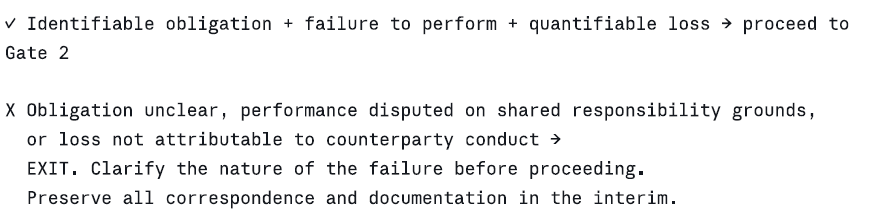
Gate 1 - Is there an identifiable claim?
A claim exists where a counterparty had a defined obligation, failed to perform that obligation, and that failure caused a quantifiable loss. Force majeure provisions, excused delays, or shared responsibility situations may affect whether a breach exists in the form the claimant believes it does.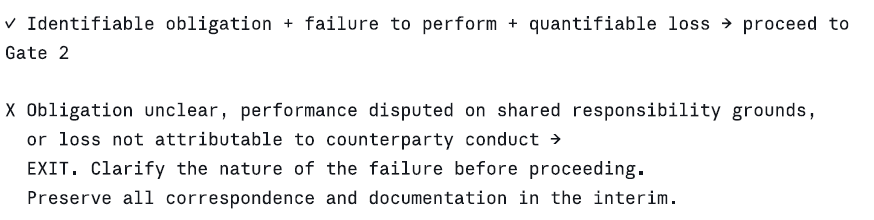
Gate 2 - Is the limitation period live?
A limitation period is the window within which a legal claim must be commenced. Once expired, a claim that is otherwise sound on the merits becomes unenforceable. The applicable limitation period depends on the governing law of the contract, which is determined in Question 1 below. The assessment at this gate is whether sufficient time remains to pursue the claim at all. Limitation periods in common law jurisdictions generally range from two to six years from the date the cause of action arose, which is generally the date of breach or the date the loss became known, depending on the jurisdiction and the nature of the claim. Some jurisdictions apply discovery-based regimes that affect when the limitation period begins to run, and certain categories of claim may attract longer periods. The applicable period depends on the governing law determined in Question 1 — where governing law is uncertain at this threshold stage, the most likely applicable limitation period should be used for this assessment with the caveat that confirmation depends on the Question 1 determination.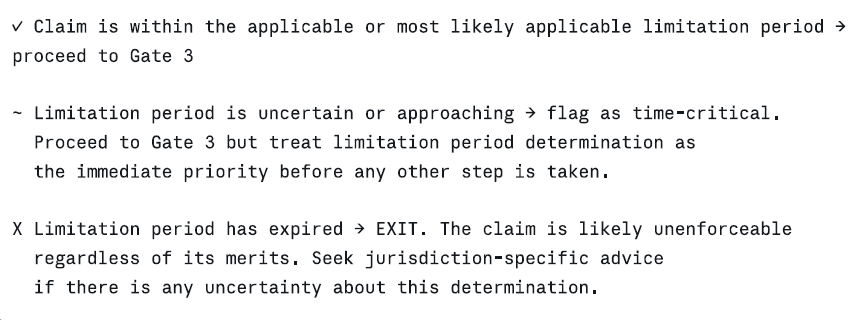
Gate 3 - Is there an identifiable legal entity against which a claim can be brought?
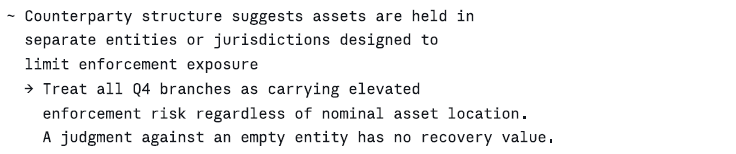
A claim requires an identifiable defendant — a legal entity with the capacity to be sued and against which a judgement can be enforced. Shell companies, dissolved entities, or counterparties operating through structures designed to insulate assets from liability may pass the surface-level identification test while failing the practical enforceability test.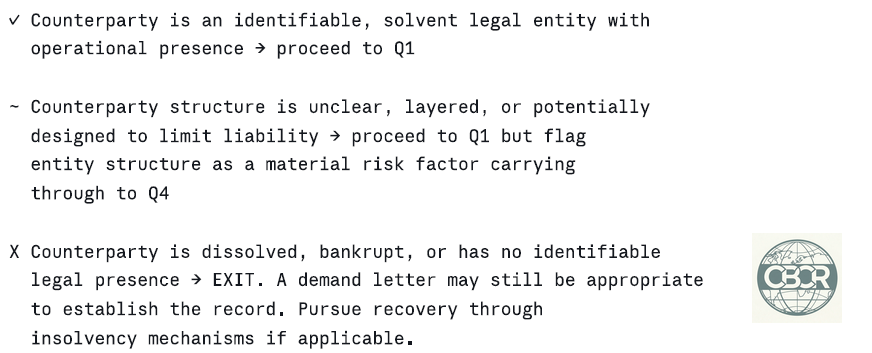
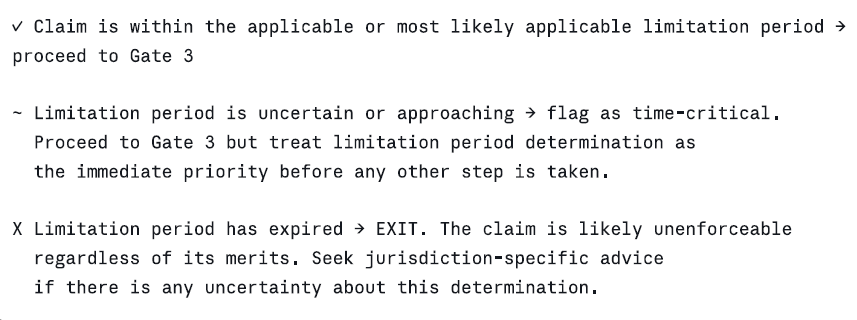
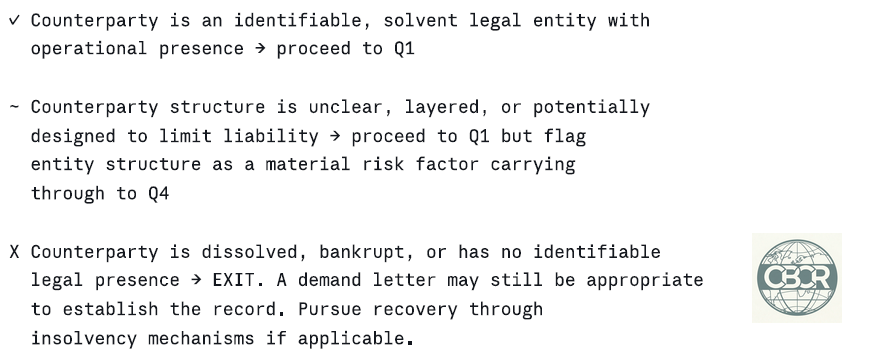
Decision Tree
The decision tree that follows is structured as a sequence of questions, each of which informs the next. The questions are designed to be worked through in order — the answer to each question shapes the analysis that follows and in some cases determines whether the assessment continues at all. Three markers are used throughout: a checkmark indicates a confirmed or favorable determination, a tilde indicates a partial or uncertain determination requiring a flag to be carried forward, and an X indicates an exit condition.
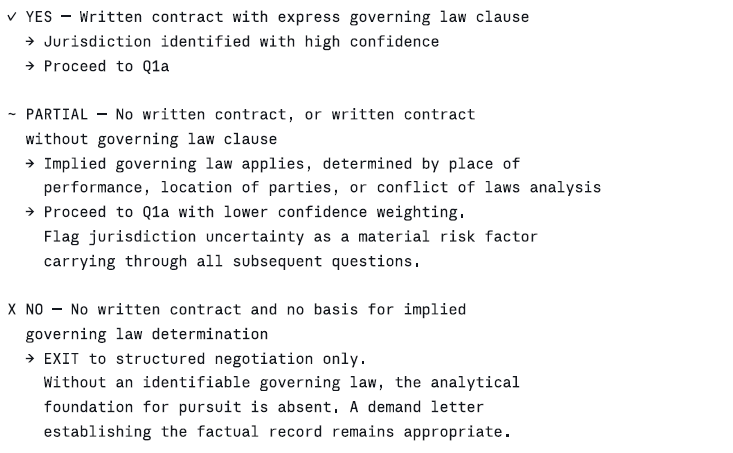
Question 1 - Is there a written contract with an express governing law clause?
The governing law determines what constitutes a valid breach, what remedies are available, how damages are calculated, and the procedural framework within which a claim must be brought. It is the foundational determination from which all subsequent analysis proceeds.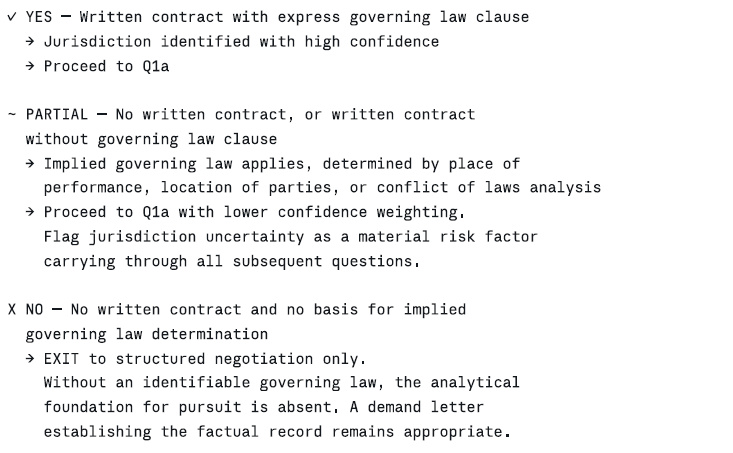
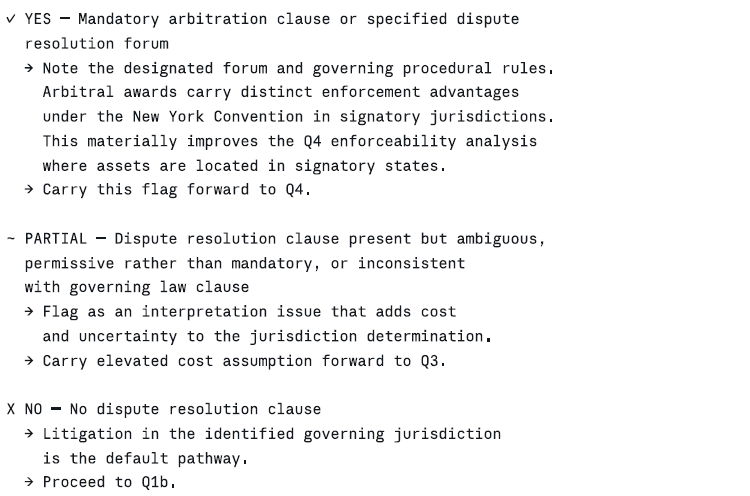
Question 1a - Does the contract contain a dispute resolution or arbitration clause?
This sub-determination sits within Question 1 and modifies the analysis that follows. It does not create a new path — rather it changes the character of the pursuit options available at the terminal stage.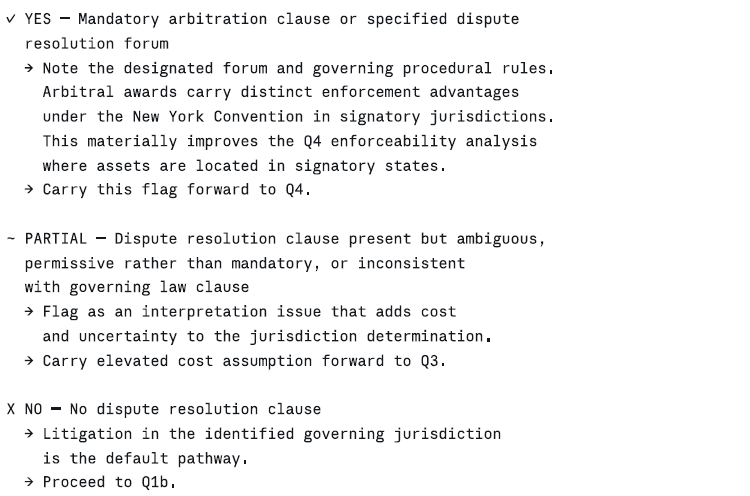
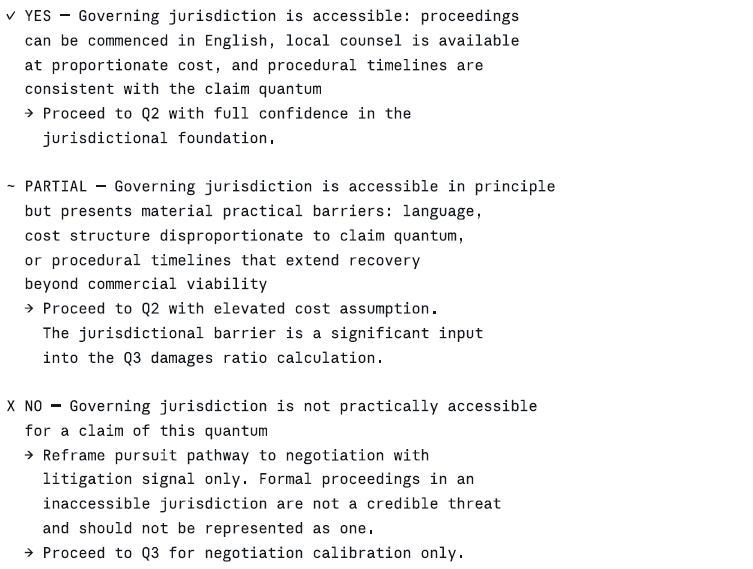
Question 1b - Is the identified jurisdiction practically accessible?
Knowing which law governs and where a claim can be brought is separate from whether that jurisdiction is operationally viable for a claimant of this size pursuing a claim of this quantum. A jurisdiction may be technically available and practically inaccessible.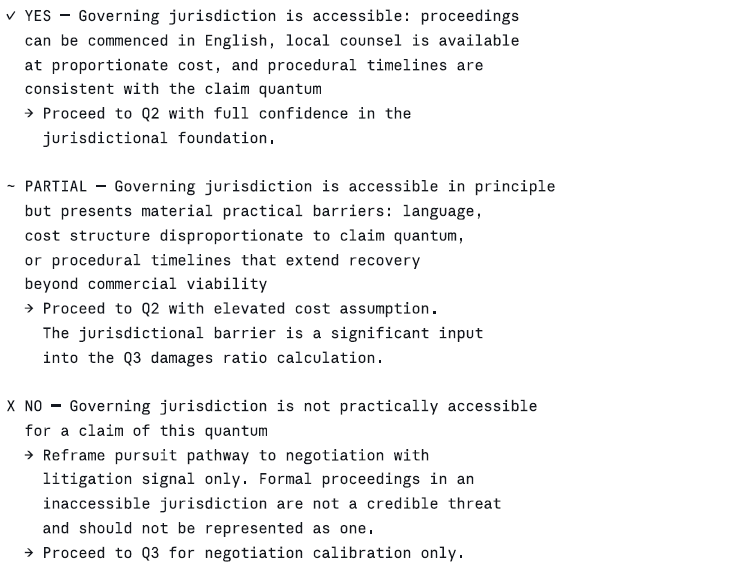
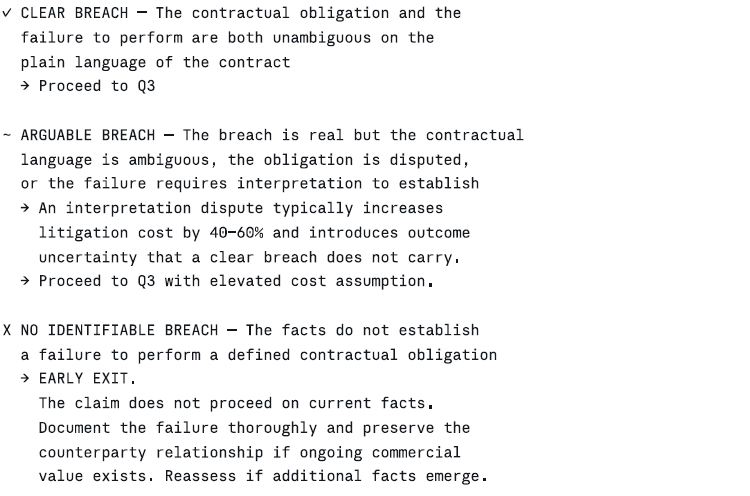
Question 2 - Is the breach unambiguous on the plain language of the contract?
A clear breach and an arguable breach are different claim types with different cost profiles and different likelihoods of success. This determination shapes both the cost assumption carried into Question 3 and the overall viability assessment.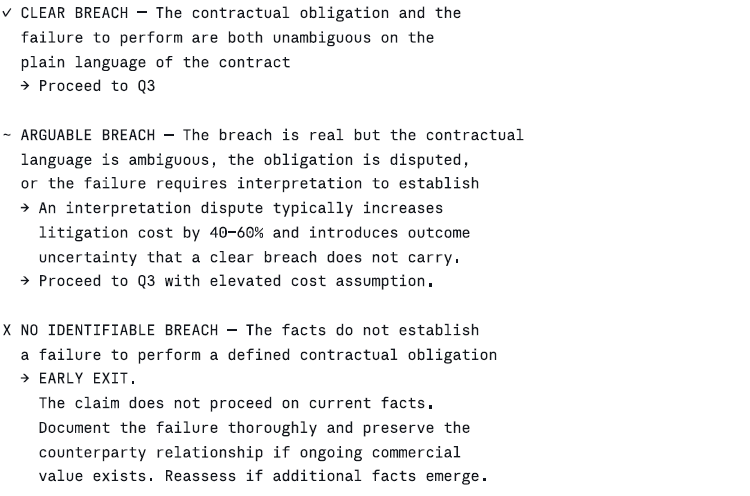
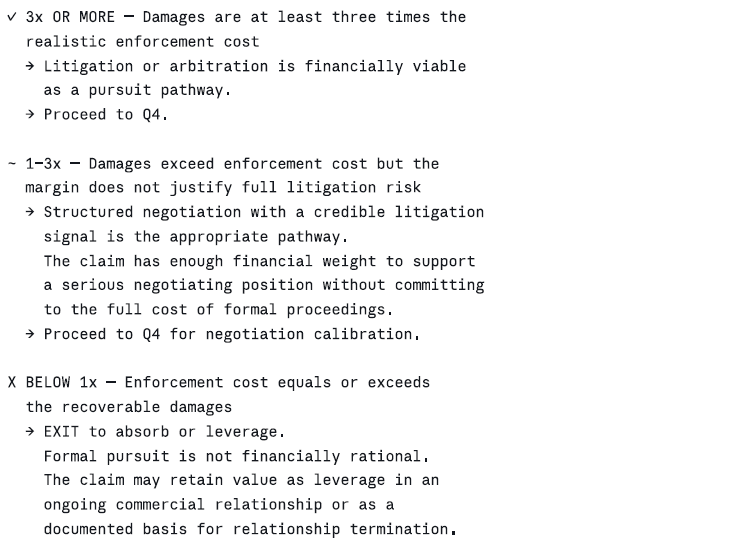
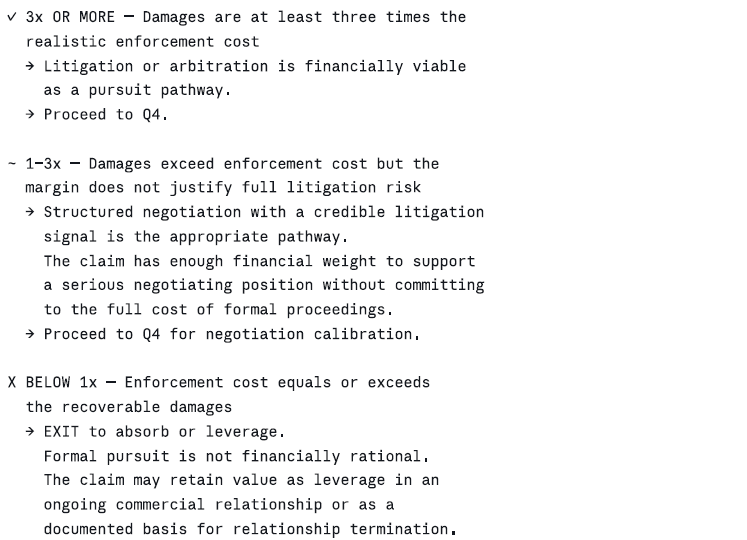
Question 3 - Are quantifiable damages at least 3x the realistic enforcement cost in the governing jurisdiction?
This is the commercial viability assessment. It integrates the cost assumptions carried forward from Questions 1 and 2 with the quantum of the loss and the realistic cost of enforcement in the identified jurisdiction. As a practical starting point, a ratio of at least 3x — damages being at least three times the estimated enforcement cost — provides a working threshold for assessing whether formal pursuit is likely to be commercially viable. This ratio is not a formally established standard but reflects the general principle that cross-border enforcement produces costs beyond legal fees alone — including management time, procedural complexity, delay, and the uncertainty inherent in operating across jurisdictions. Where the ratio falls below this threshold the commercial case for formal pursuit weakens materially, though the specific variables of each situation will affect where the viable boundary actually lies.The same principle applies to the 40-60% cost increase associated with arguable breach identified in Question 2 — this reflects a practical estimate of the additional cost introduced by contested interpretation rather than a formally derived statistical range.
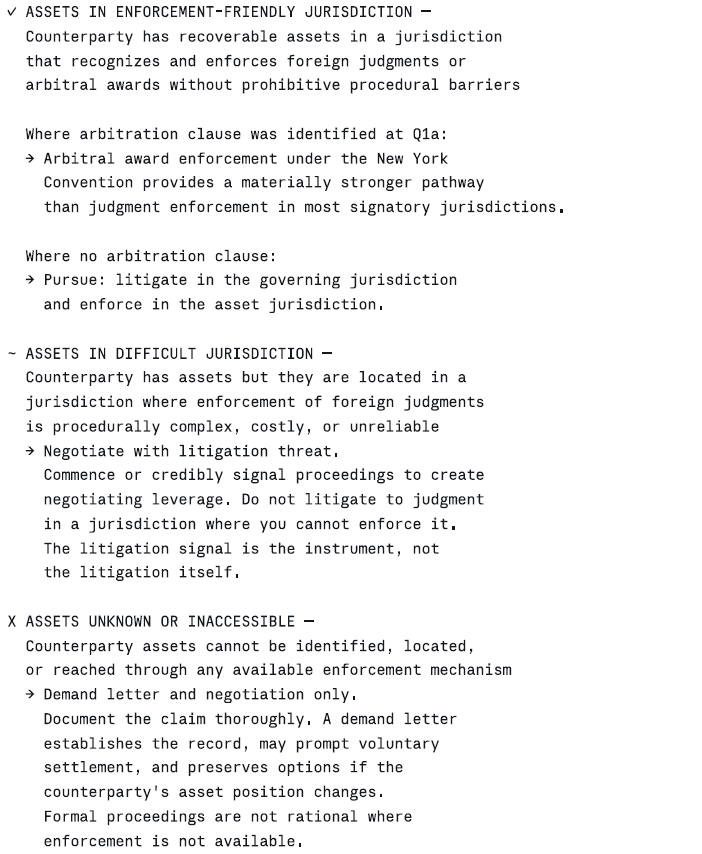
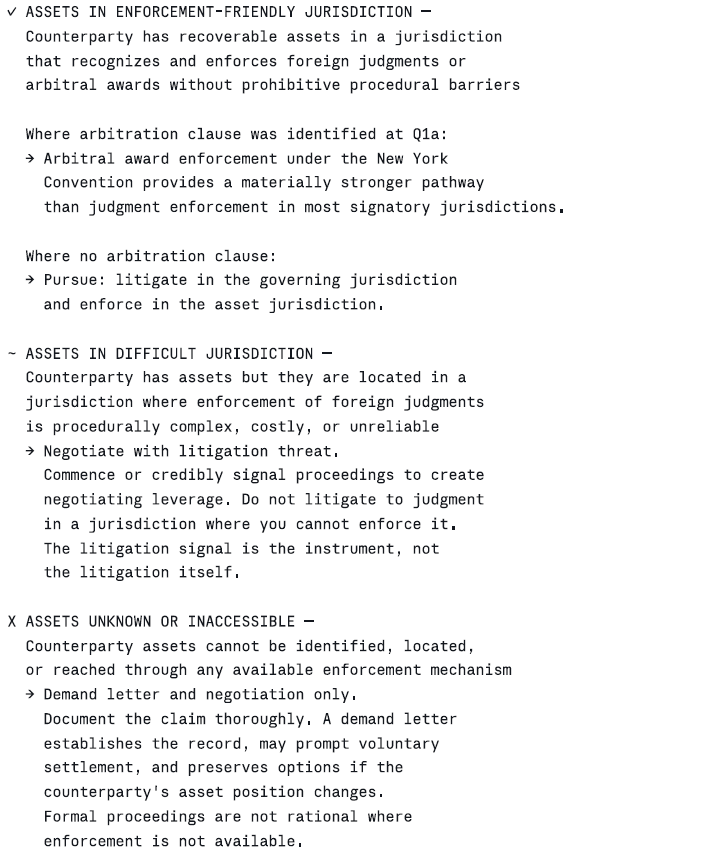
Question 4 - Does the counterparty have recoverable assets in an accessible jurisdiction?
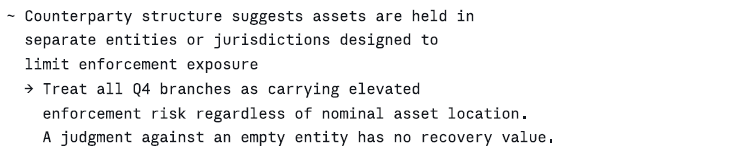
Obtaining a judgement and recovering on it are two distinct processes. This question assesses whether the counterparty has assets that are both identifiable and reachable through available enforcement mechanisms. Before assessing asset location, the solvency flag carried forward from Gate 3 should be applied where it was triggered.Solvency Check - Apply where Gate 3 flagged entity structure risk:
Asset Location Assessment:
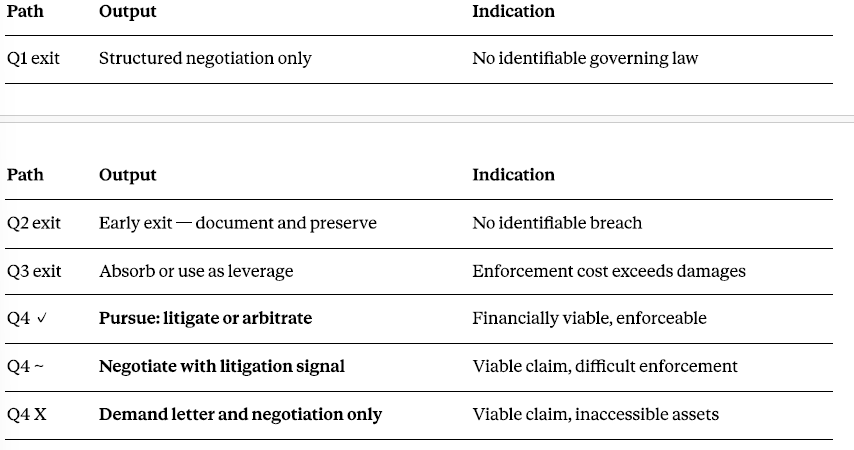
Terminal Output Summary
The following table consolidates the terminal outputs produced by the decision tree against the path that generates each one:
Summary of Confidence Modifiers
The following flags, where triggered, carry through the entire analysis and inform the reliability of the terminal output:
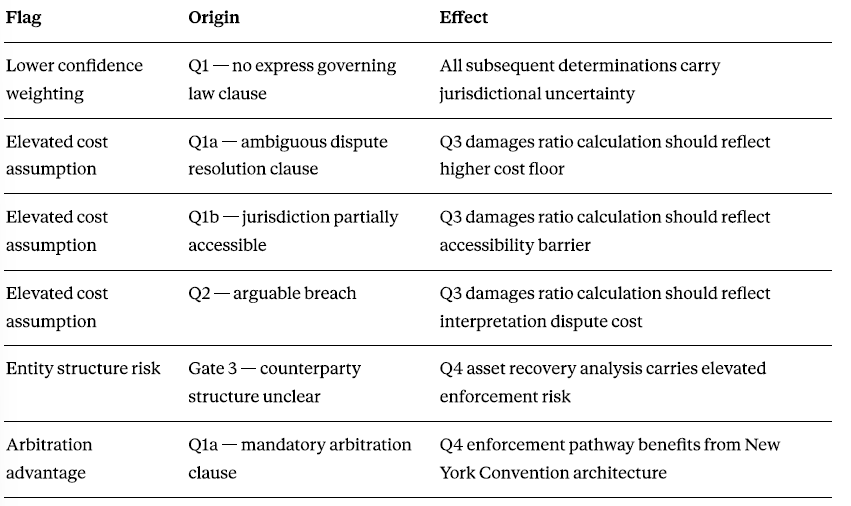
In summary, each question builds on the determination that precedes it and the terminal outputs provide a structured basis for assessing whether pursuit is commercially viable given the variables identified. Where confidence modifiers have been triggered, those flags carry through to the prompt solution and are reflected in the structured output it produces on the basis of the inputs provided.
Two additional qualifications apply to the framework above. First, the arbitral award enforcement advantage referenced at Question 1a applies where both the award jurisdiction and the enforcement jurisdiction are signatories to the New York Convention — subject to any reservations applicable in the specific enforcement jurisdiction. Second, where a demand letter is recommended as a terminal output, the implications of formal correspondence — including potential effects on limitation periods, contractual notice requirements, and insurance positions — should be considered in the context of the specific governing law before issuance.
Part 3 - Prompt Solution
This solution applies the assessment framework in the preceding section to the specific contract, the facts of the dispute, and the relevant jurisdiction.
How Prompt Will Be Used:
The entire prompt below will be copied, beginning at the system instruction through to the end of the user input fields.
The copied prompt will then be pasted into the chosen LLM.
The required information will be filled into each of the designated user input fields, in line with the illustrative scenario outlined above.
Submit and review the structured output — a sample of which is provided in the following section (Part 4).
The prompt is designed to apply the decision tree logic to the user inputs and produce a structured assessment in the required output format. The framework is intended to constrain the assessment to the logic provided — it is not designed to reason outside the framework. This cannot be guaranteed given that each AI platform processes inputs differently and applies its own reasoning characteristics. Ultimately, the output will reflect what is input into the user fields — the quality and completeness of those inputs directly shapes the usefulness of the output produced.
Prompt Solution
The following between “the quotation marks” will be copied.
“SYSTEM INSTRUCTION
Apply the following analytical framework and nothing else. Do not introduce reasoning, assumptions, or conclusions outside the framework provided. Do not speculate about facts not provided. Where the user's inputs are insufficient to complete a determination, flag the gap explicitly rather than filling it with an assumption. The output must follow the exact format specified at the end of this prompt.
FRAMEWORK - CROSS-BORDER CONTRACT CLAIM ASSESSMENT
Please apply this framework in sequence to the user inputs provided. Do not skip steps. Do not combine steps. Where a threshold condition fails, note the exit condition and do not proceed further unless instructed.
THRESHOLD CONDITIONS
Apply before proceeding to the decision question.
Gate 1 — Identifiable Claim
Assess whether the user’s inputs establish: a defined contractual obligation, a failure to perform that obligation, and a quantifiable loss attributable to that failure. Force majeure provisions, excused delays, or shared responsibility situations affect whether a breach exists in the form described.
If all three elements are present: proceed to Gate 2.
If any element is absent or unclear: flag the gap, note that the claim requires clarification before the analysis can proceed, and do not continue.
Gate 2 — Limitation Period
Assess whether the claim appears to be within the applicable limitation period. Limitation periods in common law jurisdictions typically range from two to six years from the date of breach or the date the loss became known. The applicable period depends on the governing law.
If the claim appears within the applicable or most likely applicable limitation period: proceed to Gate 3.
If the limitation period is uncertain or approaching: flag as time-critical, proceed to Gate 3, and note that limitation period determination is the immediate priority.
If the limitation period appears to have expired: flag as a likely fatal bar to the claim, note that jurisdiction-specific advice is required, and do not proceed further.
Gate 3 — Identifiable Legal Entity
Assess whether the counterparty is an identifiable legal entity against which a claim can be brought and a judgement enforced. Assess whether the entity structure described by the user raises any flags regarding asset insulation, shell company structures, or insolvency.
If the counterparty is a clearly identifiable, apparently solvent legal entity: proceed to Question 1.
If the entity structure is unclear, layered, or potentially designed to limit liability: proceed to Question 1 and carry an entity structure risk flag through to Question 4.
If the counterparty is dissolved, bankrupt, or has no identifiable legal presence: flag exit condition, note that insolvency recovery mechanisms may apply, and do not proceed further.
DECISION QUESTIONS
Apply in sequence after threshold conditions are confirmed.
Question 1 — Governing Law
Assess whether the contract contains an express governing law clause. If yes, identify the governing jurisdiction. If no, assess implied governing law based on the user’s description of place of performance and location of parties.
Express governing law clause present: identify jurisdiction, proceed to Q1a with high confidence.
No express clause but implied governing law determinable: identify most likely governing jurisdiction, proceed to Q1a with lower confidence weighting, flag jurisdiction uncertainty as a material risk factor.
No governing law clause and implied governing law not determinable: flag exit condition — structured negotiation only. Note that without identifiable governing law the analytical foundation for formal pursuit is absent.
Question 1a — Dispute Resolution or Arbitration Clause
Assess whether the contract contains a mandatory arbitration clause or specified dispute resolution forum.
Mandatory arbitration clause present: identify the designated forum and note that arbitral award enforcement under the New York Convention provides a materially stronger enforcement pathway than judgement enforcement in most signatory jurisdictions. Carry arbitration advantage flag forward to Q4.
Dispute resolution clause present but ambiguous or permissive: flag as an interpretation issue that adds cost and uncertainty. Carry elevated cost assumption forward to Q3.
No dispute resolution clause: litigation in the identified governing jurisdiction is the default pathway. Proceed to Q1b.
Question 1b — Practical Jurisdiction Accessibility
Assess whether the identified jurisdiction is practically accessible for a claimant of the apparent scale described by the user, for a claim of the quantum provided.
Jurisdiction accessible — proceedings in English, proportionate cost structure, timelines consistent with claim quantum: proceed to Q2 with full confidence in the jurisdictional foundation.
Jurisdiction partially accessible — material practical barriers present but not prohibitive: proceed to Q2 with elevated cost assumption, note the specific barrier identified.
Jurisdiction not practically accessible for a claim of this quantum: reframe pursuit pathway to negotiation with litigation signal only. Proceed to Q3 for negotiation calibration.
Question 2 — Breach Assessment
Assess whether the breach is unambiguous on the plain language of the contract as described by the user.
Clear breach — obligation and failure to perform both unambiguous: proceed to Q3.
Arguable breach — breach is real but contractual language is ambiguous or requires interpretation: note that an interpretation dispute can materially increase litigation cost — estimates in practice suggest a range of 40-60% above the base cost of a clear breach claim, reflecting the additional expert evidence, extended pleadings, and outcome uncertainty that ambiguous contractual language typically introduces. Carry elevated cost assumption to Q3.
No identifiable breach — facts as described do not establish failure to perform a defined obligation: flag early exit. Note that the claim does not proceed on current facts. Document the failure thoroughly. Where ongoing commercial value exists in the counterparty relationship, that consideration may warrant attention alongside the documentation of the failure.
Question 3 — Damages Ratio
Calculate the ratio of the user’s estimated damages value to their estimated enforcement cost. Apply any elevated cost assumptions carried forward from Q1a, Q1b, or Q2.
3x or more — damages are at least three times the realistic enforcement cost: litigation or arbitration is financially viable. Proceed to Q4.
1-3x — damages exceed enforcement cost but the margin does not justify full litigation risk: structured negotiation with a credible litigation signal is the more appropriate pathway given the margin. Proceed to Q4 for negotiation calibration.
Below 1x — enforcement cost equals or exceeds recoverable damages: flag exit to absorb or use as leverage. Note that formal pursuit is not commercially viable on the figures provided.
Question 4 — Asset Recovery Assessment
Apply entity structure risk flag from Gate 3 if triggered. Where entity structure risk is flagged, note that all branches carry elevated enforcement risk regardless of nominal asset location.
Assess whether the counterparty has recoverable assets in an accessible jurisdiction based on the user’s inputs.
Assets in enforcement-friendly jurisdiction — counterparty has recoverable assets in a jurisdiction that recognizes and enforces foreign judgements or arbitral awards without prohibitive procedural barriers: where arbitration clause was identified at Q1a, note that the New York Convention provides a materially stronger enforcement pathway. Where no arbitration clause, pursue by litigating in the governing jurisdiction and enforcing in the asset jurisdiction.
Assets in a jurisdiction where enforcement is procedurally complex, costly, or unreliable: negotiate with litigation threat. Commence or credibly signal proceedings to create leverage. Litigating to judgement in a jurisdiction where enforcement is unavailable produces no recovery value. The litigation signal is the instrument, not the litigation itself.
Assets unknown or inaccessible — counterparty assets cannot be identified, located, or reached through any available enforcement mechanism: demand letter and negotiation only. Note that a demand letter establishes the record and may prompt voluntary settlement. Formal proceedings are not commercially viable where enforcement is unavailable.
USER INPUTS
Complete all fields before submitting.
All fields should be completed before submitting. Specific and complete information should be provided for each field listed below — the more specific and complete the inputs, the more useful the output will likely be. Where the information is not available, the field should be marked as unknown rather than left blank.Contract governing law clause — the exact text of the governing law clause will be pasted here. If none is available, indicate: “None.”
Dispute resolution or arbitration clause — the exact text of the dispute resolution or arbitration clause will be pasted here. If none is available, indicate: “None.”
Description of the alleged breach — the specific obligation that was not performed will be described here, including when and how the failure occurred and the documentation available to support the description. Any force majeure provisions, excused delay arguments, or shared responsibility circumstances that may affect whether a breach exists in the form described should also be noted here.
Counterparty entity information — the following will be provided: name, jurisdiction of incorporation, and any known information about corporate structure or related entities.
Estimated damages value — the quantifiable loss suffered, expressed as a specific figure.
Estimated enforcement cost — the best estimate of the cost of pursuing this potential claim to judgement in the governing jurisdiction. This figure should include both legal fees and any procedural or administrative costs associated with proceedings in the identified jurisdiction.
Known assets of the counterparty and their location — what is known about the counterparty’s assets and where they are held will be described here.
Limitation period information — the date the breach occurred, or the date awareness of the loss was first established, whichever is later.
REQUIRED OUTPUT FORMAT
Produce the output in the following format exactly. Do not add sections. Do not omit sections. Where a determination cannot be made from the inputs provided, state "insufficient information" and specify what additional information is required.
Threshold Assessment:
Gate 1 — Identifiable claim: [confirmed / requires clarification — specify gap]
Gate 2 — Limitation period: [within period / time-critical — flag / likely expired — flag]
Gate 3 — Legal entity: [confirmed / entity structure risk flagged / exit — specify reason]
Decision Analysis:
Governing law: [identified jurisdiction / uncertainty flag] + confidence level for this determination
Dispute resolution pathway: [litigation / arbitration — specify forum / ambiguous — flag]
Jurisdiction accessibility: [accessible / partial — specify barrier / inaccessible]
Breach assessment: [clear / arguable / not established] + one sentence reason
Damages ratio: [calculated ratio] + note any elevated cost assumptions applied
Asset accessibility: [accessible / uncertain / inaccessible] + note entity structure risk if flagged
Recommended Path:
[pursue litigation / pursue arbitration / negotiate with litigation signal / demand letter and negotiation only / exit — specify reason]
Confidence Modifiers Applied:
[list any flags carried forward — lower confidence weighting / elevated cost assumption / entity structure risk / arbitration advantage — and the question at which each was triggered]
Overall Confidence Level:
[high / medium / low] + primary reason for uncertainty if medium or low
Referral Recommendation:
This field must appear in every output regardless of confidence level.
Specify whether the situation warrants professional engagement and on what specific question. Where confidence is low, where multiple modifiers have been triggered, where the limitation period is time-critical, or where the entity structure raises material enforcement risk, state: “Professional engagement is recommended on [specify the specific question] before any decisive action is taken.”
Where confidence is high and no material modifiers have been triggered, state: 'No immediate referral is required on the basis of this assessment alone. Professional engagement remains advisable before committing to any formal pursuit pathway and is recommended before commencing formal proceedings.”
###END OF PROMPT###
A Note on Output and Additional Considerations
The prompt requires the Large Language Model (LLM) to apply a specific framework to a specific set of inputs and produce a specific format of output. Based on its construction, the LLM is not intended to philosophize, speculate, or reason outside the framework provided. The variability that exists in open-ended LLM interactions is constrained here by three mechanisms: the system instruction which defines the operating parameters, the framework which defines the analytical steps, and the output format which defines what the response must contain. The LLM is an execution engine for the decision tree logic — not a free reasoner applying general knowledge to the situation. The field is still developing and the reliability of constrained framework reasoning within LLM platforms is likely to improve as the technology matures.
Output will vary across LLM platforms and across sessions because generative AI is inherently variable in its reasoning process. This is not a defect in the prompt — it is a characteristic of the medium. The format and the framework are designed to be stable. The reasoning applied within that framework will reflect the specific inputs provided and the characteristics of the platform used. The output is intended to be treated as a starting point rather than a definitive determination.
Before using the prompt solution with a commercially available LLM, the confidentiality implications of doing so should be carefully considered.
Most publicly available LLMs do not guarantee confidentiality of user inputs. Depending on the platform’s privacy policy and data handling practices, inputs may be reviewed by platform operators, used to train or improve the model, or stored in ways that are not fully within the user’s control. For inputs that include sensitive commercial information — actual contract terms, dispute facts, counterparty details, or financial figures — this represents a material confidentiality risk that should be assessed before submission.
Users with access to enterprise versions of LLM platforms, where available, which typically offer stronger data handling commitments and opt-out provisions for training data use — should consider using those versions in preference to publicly available interfaces when inputting sensitive information.
The most robust solution for users handling genuinely sensitive commercial information is a privately hosted LLM — a model deployed within a controlled environment where inputs are not transmitted to or stored by any third party. This option is becoming increasingly accessible as local deployment tools develop but requires technical capability that not all users will have readily available.
At minimum, the privacy policy of any LLM platform used should be reviewed before sensitive information is input. Where the sensitivity of the information involved is high, anonymizing or hypothesizing the key facts before input — substituting fictional figures and entity names for actual ones — provides a practical middle ground between using the prompt with real data and not using it at all. What is appropriate to input into a public LLM for a hypothetical or anonymized scenario may not be appropriate for actual commercial facts and documents.
This piece is published for informational and analytical purposes only. It does not constitute legal advice. The frameworks and tools presented here are general in nature and do not account for the specific facts, circumstances, or jurisdictional requirements of any individual situation. For advice specific to your situation, consult a qualified legal professional licensed in your jurisdiction.